Sunil Kumar
The 14th President of Tufts University

Sunil Kumar assumed office on July 1, 2023. He is strongly committed to preserving, and furthering, the university’s mission of being a student-centered research university that is dedicated to the creation and application of knowledge, and to providing transformative experiences for students and faculty in an inclusive and collaborative environment, where creative scholars generate bold ideas, innovate in the face of complex challenges, and distinguish themselves as active citizens of the world.
To be Tufts is to take the original mission seriously—to be the light on the hill ... not to show off that it is brighter than others, but to make sure that it provides light that others can use to advance their own lives.
Sunil Kumar
About President Kumar
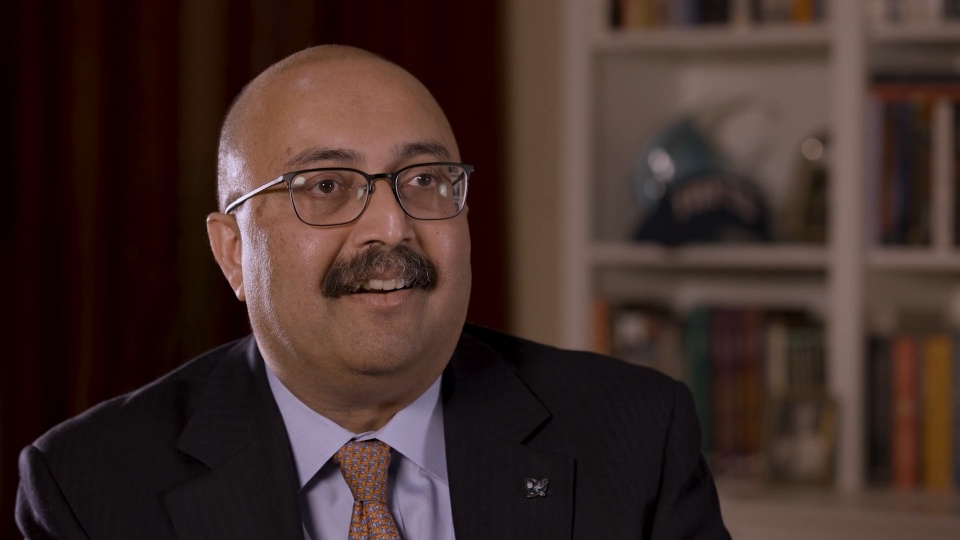
Sunil Kumar is the president of Tufts University and assumed office on July 1, 2023. He is the 14th president of Tufts and the first person of color to hold the office. He also serves as a professor in the Department of Electrical and Computer Engineering at Tufts University’s School of Engineering.
At Tufts, Kumar is strongly committed to preserving and enhancing the emphasis on a liberal arts undergraduate education within a tight-knit and student-centered environment. He is also focused on enabling conditions that foster cutting-edge teaching and world-class research that serves both national and global interests through Tufts’ many graduate and professional schools.
Prior to Tufts, Kumar served as the 15th provost of Johns Hopkins University (JHU) from 2016-2023 and as Dean of the University of Chicago’s Booth School of Business, as well as the George Pratt Shultz Professor of Operations Management from 2011-2016. Before joining the Booth School of Business, he spent 14 years on the faculty of the Stanford University Graduate School of Business, where he was the Fred H. Merrill Professor of Operations, Information and Technology and served as the senior associate dean for academic affairs, overseeing the school’s MBA program and leading faculty groups in marketing and organizational behavior.
Kumar’s research includes performance evaluation and control of manufacturing systems, service operations, and communications networks. In particular, he studies systems affected by stochastic variability via mathematical models. He also studies application of optimization methods and control theory to managerial problems.
Born in India, Kumar received a Master of Engineering degree in computer science and automation from the Indian Institute of Science in Bangalore and a Bachelor of Engineering degree from Mangalore University in Surathkal. He earned a PhD in electrical engineering from the University of Illinois at Urbana-Champaign.